







The Riverbed Recalls the River
2026.07.19-2026.10.25
Artist
Barthélémy Toguo
Hu Weiyi
Barthélémy Toguo
Hu Weiyi
Organizer
Yi Space
Yi Space
Curator
Zhu Zhu
Zhu Zhu
Supporter
HdM Gallery
HdM Gallery
Address
Yi Space, 46-1 Siyi Road, Qingbo Street,Shangcheng<br/>District,Hangzhou City, Zhejiang province
Yi Space, 46-1 Siyi Road, Qingbo Street,Shangcheng<br/>District,Hangzhou City, Zhejiang province
"A riverbed never forgets its river, just as the earth never forgets every wind that has passed across it, every rain that has fallen upon it."
— Bao'erji Yuanye, The Riverbed Recalls the River
To live is to move through an endless succession of losses and farewells. Some leave behind the land that raised them; some witness the transformation of the cities they once called home; others quietly confront the ageing and eventual decline of the body itself. Yet nothing that has vanished is ever entirely lost. What disappears lingers instead in fragments: in the patterned fabrics folded into a traveller's bundle, in the dust suspended above abandoned ruins, in flowers blooming beside forgotten bones. They settle silently into every barren riverbed that life leaves behind.
The migrants who populate Barthélémy Toguo's work are rivers forced away from their original riverbeds. Reflecting on the recurring motif of the "bundle" in his practice, Toguo explains that the African wax-print cloth wrapped around these parcels contains an entire genealogy of home: family lineage, personal memory, cultural inheritance, and the deepest longings of the heart. Migration is never merely a geographical relocation. It is the act of carrying one's homeland through the world, entrusting an entire life's destiny to the uncertain current ahead.
Constructed from traditional African textiles, Toguo's bundles become vessels of collective memory, bearing witness to histories of migration, displacement, and the enduring scars of colonialism experienced across the African continent. Yet the emotional condition they embody reaches far beyond a single geography. Those who have left home in search of another life, as well as diasporic communities dispersed across the world, may all recognise their own experiences of uprootedness within these works, finding resonance in a condition of displacement that transcends nation, ethnicity, and culture.
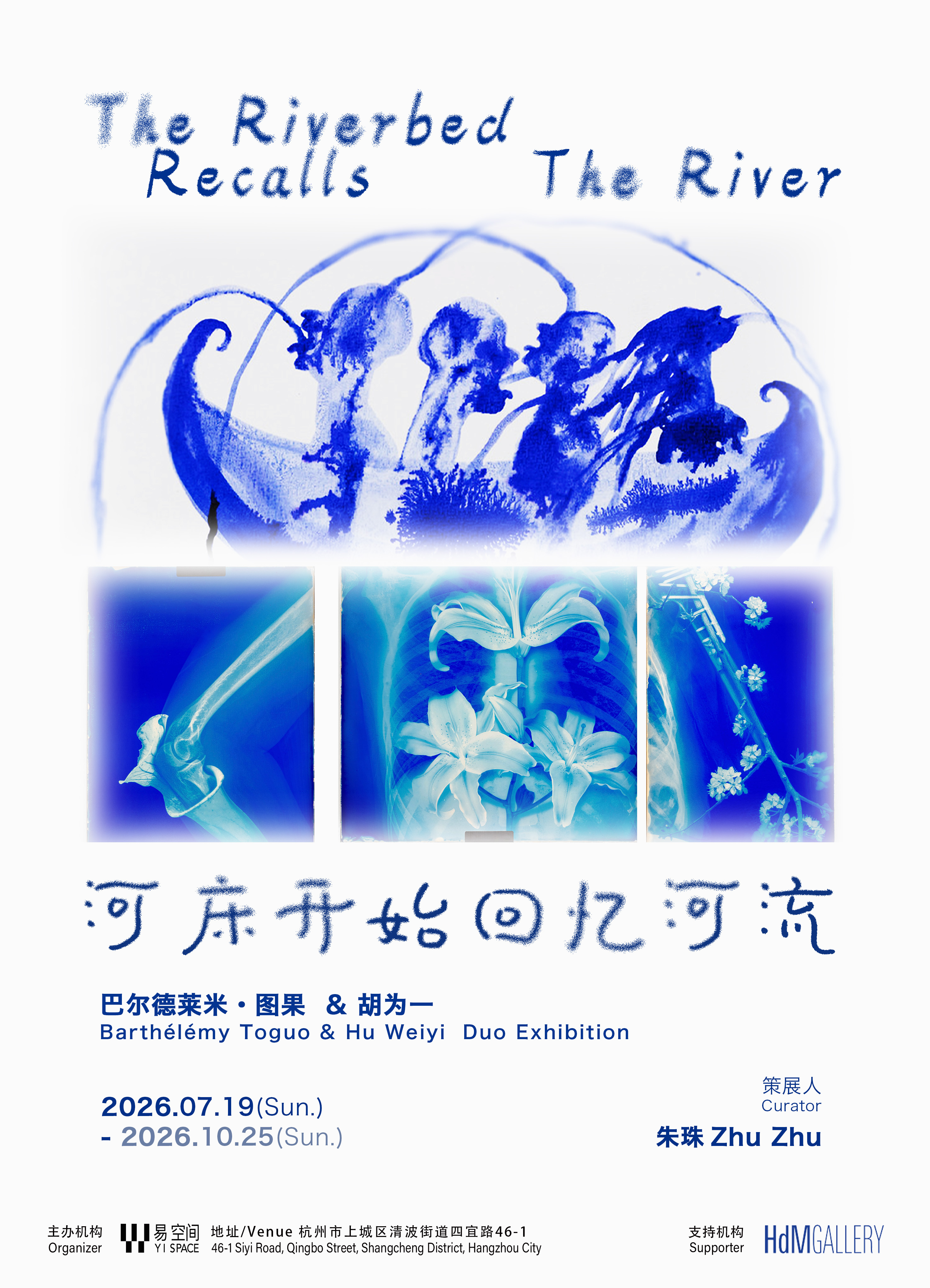
Alongside his monumental installations, Toguo regards his works on paper as "an extended breathing exercise." Ink is allowed to flow freely across the page, bleeding, dispersing and unfolding according to its own rhythm. Through spontaneous gestures of brush and wash, he captures the most immediate states of the spirit. As Toguo has remarked, ink knows no boundaries, just as humanity and nature have never truly existed apart. Mountains, forests, plants, animals, and human beings all belong to the same living continuum.
In Human Nature Series, all forms of life intertwine, merge and coexist, dissolving the conventional boundaries between humanity and nature, between the individual and the world. Encountering Toguo's work, one is consistently struck by an expansive sense of compassion, coupled with an almost imperceptible tenderness. It is this quiet yet resilient humanity that lies at the heart of his artistic practice, giving rise to works that are at once deeply passionate and profoundly poetic.
The other artist featured in this exhibition, Hu Weiyi, once reflected in an interview that whenever he enters abandoned buildings or deserted construction sites, the graffiti left upon crumbling walls, the scattered fragments beneath his feet, and the dust suspended in the air all become the city's final whispers after its curtain has fallen. When the grandeur of civilisation recedes, what remains are empty architectural skeletons, silently holding within them the accumulated memories of another time.
Hu’s series The dust now inhaled was once a house and Blueprint construct desolate yet strangely dreamlike urban landscapes through the combined use of actual ruins, life-sized architectural models, and the cyanotype process. The flowers that burst into bloom amid abandoned walls resemble fresh water returning to a dried riverbed, allowing new life to emerge from the very ground of disappearance.
These works focus on a defining paradox of China's urbanisation: while cities continue to expand at extraordinary speed, countless places are simultaneously left behind, forgotten, or abandoned. With remarkable restraint and lyricism, Hu preserves these vanishing fragments of time and space, gently suspending the collective memories embedded within an era of relentless transformation. Like a riverbed remembering its river, his work invites us to reflect upon what quietly disappears in the name of progress, and what is irretrievably lost with every cycle of renewal.
In The Miracle of Flowers, Hu overturns an anthropocentric mode of representation by placing flowers—long relegated to the margins of history—at the centre of artistic attention. The accompanying installation Dream Body layers X-ray films of the human skeleton with blooming flowers through the cyanotype process, forming illuminated skeletal structures that evoke both fracture and regeneration. Hu describes the work as a dialogue between mortality and vitality: the X-ray serves as uncompromising evidence of the body, exposing illness, ageing and death with clinical directness, while the blossoms offer themselves as acts of living sacrifice, allowing new vitality to arise precisely where desolation and disappearance seem complete. Although their artistic languages differ profoundly, both Hu and Toguo are ultimately concerned with the same enduring questions: disappearance and renewal, transience and remembrance.
As both an actor and the curator of this exhibition, I recognise in these two distinct artistic practices two seemingly opposite paths that nevertheless arrive at the same truth. Their approaches closely parallel two fundamental methodologies through which performance reaches emotional authenticity.
The first begins with emotion and moves outward. Genuine action grows from inward empathy and lived feeling; the emotional state precedes behaviour. This forms the foundation of Konstantin Stanislavski's early system of psychological experience. One first imagines and truly feels anger, and only then is driven to smash the glass.
The second begins with action and moves inward. According to this approach, authentic emotion cannot simply be summoned through willpower, but can instead emerge through concrete physical action and direct engagement with circumstance. One first shatters the glass; then the sound of breaking, the force transmitted through the body, the splash of water and the scattering fragments become catalysts that awaken genuine emotional response. This later development of Stanislavski's Method of Physical Actions also resonates strongly with contemporary theories of embodied cognition.
To me, Barthélémy Toguo is an artist who begins with emotion and moves outward. Empathy is the point of departure for all that he creates. He first immerses himself in the emotional reality of those who have been displaced—the hardship of leaving home, the uncertainty of living without roots, and the unwavering determination to seek a new beginning. Carrying these deeply felt emotions within him, he transforms profound human experience and compassion into tangible visual form. The densely wrapped bundles of wax-print cloth, the boats suspended in space, and the myriad living beings intertwined through ink are not carefully orchestrated spectacles. They are the most natural and sincere outpourings of an inner landscape, where memory, emotion, and humanity flow together.
Hu Weiyi, by contrast, begins with action and moves inward. His practice does not originate from a predetermined emotional state, nor does it seek to impose a fixed conceptual framework upon the work. He rarely prescribes a definitive interpretation or confines his practice within stable categories, resisting any attempt to reduce art to a single meaning. Instead, he returns again and again to abandoned sites, gathering dust, reproducing architectural surfaces, refining the structures of his installations, layering skeletal imagery with flowers, and repeatedly exposing and developing cyanotypes. He embraces contingency throughout the process of making, allowing unforeseen encounters and unexpected deviations to shape the work as it unfolds. Through an external practice of extraordinary discipline, restraint, and precision, he constructs a material environment from which reflection gradually emerges, allowing thought—and ultimately inner understanding—to arise through action itself.
If Toguo is a river in perpetual motion, surging towards renewal, then Hu Weiyi is the riverbed: still, enduring, and capacious enough to receive all that passes through it. Long after civilisations have receded, lives have come to an end, and time itself has flowed onward, the riverbed quietly preserves every trace, every memory, and every tenderness that has not entirely disappeared.
Movement and stillness, migration and permanence, disappearance and regeneration—these are the shared currents through which the works of Toguo and Hu illuminate one another. Though their artistic languages diverge, both artists return to the fundamental conditions of human existence: the fragile coexistence between humanity and nature, the continual negotiation between individual lives and historical change, and the quiet resilience through which life persists even in moments of fracture. Together, their works unfold as a poetic dialogue on memory, loss, and the enduring capacity for renewal.
As Bao'erji Yuanye writes:
The riverbeds upon the earth are like empty sacks. Once the grain is gone, the sack reveals its vastness... A dried riverbed seems to remember. It holds a silence that does not belong to it, recalling the roar of rushing water and the chorus of frogs. It remembers what water is. It remembers the current flowing over pebbles, through grasses, and beneath the stars.
— Bao'erji Yuanye, The Riverbed Recalls the River
To live is to move through an endless succession of losses and farewells. Some leave behind the land that raised them; some witness the transformation of the cities they once called home; others quietly confront the ageing and eventual decline of the body itself. Yet nothing that has vanished is ever entirely lost. What disappears lingers instead in fragments: in the patterned fabrics folded into a traveller's bundle, in the dust suspended above abandoned ruins, in flowers blooming beside forgotten bones. They settle silently into every barren riverbed that life leaves behind.
The migrants who populate Barthélémy Toguo's work are rivers forced away from their original riverbeds. Reflecting on the recurring motif of the "bundle" in his practice, Toguo explains that the African wax-print cloth wrapped around these parcels contains an entire genealogy of home: family lineage, personal memory, cultural inheritance, and the deepest longings of the heart. Migration is never merely a geographical relocation. It is the act of carrying one's homeland through the world, entrusting an entire life's destiny to the uncertain current ahead.
Constructed from traditional African textiles, Toguo's bundles become vessels of collective memory, bearing witness to histories of migration, displacement, and the enduring scars of colonialism experienced across the African continent. Yet the emotional condition they embody reaches far beyond a single geography. Those who have left home in search of another life, as well as diasporic communities dispersed across the world, may all recognise their own experiences of uprootedness within these works, finding resonance in a condition of displacement that transcends nation, ethnicity, and culture.
Alongside his monumental installations, Toguo regards his works on paper as "an extended breathing exercise." Ink is allowed to flow freely across the page, bleeding, dispersing and unfolding according to its own rhythm. Through spontaneous gestures of brush and wash, he captures the most immediate states of the spirit. As Toguo has remarked, ink knows no boundaries, just as humanity and nature have never truly existed apart. Mountains, forests, plants, animals, and human beings all belong to the same living continuum.
In Human Nature Series, all forms of life intertwine, merge and coexist, dissolving the conventional boundaries between humanity and nature, between the individual and the world. Encountering Toguo's work, one is consistently struck by an expansive sense of compassion, coupled with an almost imperceptible tenderness. It is this quiet yet resilient humanity that lies at the heart of his artistic practice, giving rise to works that are at once deeply passionate and profoundly poetic.
The other artist featured in this exhibition, Hu Weiyi, once reflected in an interview that whenever he enters abandoned buildings or deserted construction sites, the graffiti left upon crumbling walls, the scattered fragments beneath his feet, and the dust suspended in the air all become the city's final whispers after its curtain has fallen. When the grandeur of civilisation recedes, what remains are empty architectural skeletons, silently holding within them the accumulated memories of another time.
Hu’s series The dust now inhaled was once a house and Blueprint construct desolate yet strangely dreamlike urban landscapes through the combined use of actual ruins, life-sized architectural models, and the cyanotype process. The flowers that burst into bloom amid abandoned walls resemble fresh water returning to a dried riverbed, allowing new life to emerge from the very ground of disappearance.
These works focus on a defining paradox of China's urbanisation: while cities continue to expand at extraordinary speed, countless places are simultaneously left behind, forgotten, or abandoned. With remarkable restraint and lyricism, Hu preserves these vanishing fragments of time and space, gently suspending the collective memories embedded within an era of relentless transformation. Like a riverbed remembering its river, his work invites us to reflect upon what quietly disappears in the name of progress, and what is irretrievably lost with every cycle of renewal.
In The Miracle of Flowers, Hu overturns an anthropocentric mode of representation by placing flowers—long relegated to the margins of history—at the centre of artistic attention. The accompanying installation Dream Body layers X-ray films of the human skeleton with blooming flowers through the cyanotype process, forming illuminated skeletal structures that evoke both fracture and regeneration. Hu describes the work as a dialogue between mortality and vitality: the X-ray serves as uncompromising evidence of the body, exposing illness, ageing and death with clinical directness, while the blossoms offer themselves as acts of living sacrifice, allowing new vitality to arise precisely where desolation and disappearance seem complete. Although their artistic languages differ profoundly, both Hu and Toguo are ultimately concerned with the same enduring questions: disappearance and renewal, transience and remembrance.
As both an actor and the curator of this exhibition, I recognise in these two distinct artistic practices two seemingly opposite paths that nevertheless arrive at the same truth. Their approaches closely parallel two fundamental methodologies through which performance reaches emotional authenticity.
The first begins with emotion and moves outward. Genuine action grows from inward empathy and lived feeling; the emotional state precedes behaviour. This forms the foundation of Konstantin Stanislavski's early system of psychological experience. One first imagines and truly feels anger, and only then is driven to smash the glass.
The second begins with action and moves inward. According to this approach, authentic emotion cannot simply be summoned through willpower, but can instead emerge through concrete physical action and direct engagement with circumstance. One first shatters the glass; then the sound of breaking, the force transmitted through the body, the splash of water and the scattering fragments become catalysts that awaken genuine emotional response. This later development of Stanislavski's Method of Physical Actions also resonates strongly with contemporary theories of embodied cognition.
To me, Barthélémy Toguo is an artist who begins with emotion and moves outward. Empathy is the point of departure for all that he creates. He first immerses himself in the emotional reality of those who have been displaced—the hardship of leaving home, the uncertainty of living without roots, and the unwavering determination to seek a new beginning. Carrying these deeply felt emotions within him, he transforms profound human experience and compassion into tangible visual form. The densely wrapped bundles of wax-print cloth, the boats suspended in space, and the myriad living beings intertwined through ink are not carefully orchestrated spectacles. They are the most natural and sincere outpourings of an inner landscape, where memory, emotion, and humanity flow together.
Hu Weiyi, by contrast, begins with action and moves inward. His practice does not originate from a predetermined emotional state, nor does it seek to impose a fixed conceptual framework upon the work. He rarely prescribes a definitive interpretation or confines his practice within stable categories, resisting any attempt to reduce art to a single meaning. Instead, he returns again and again to abandoned sites, gathering dust, reproducing architectural surfaces, refining the structures of his installations, layering skeletal imagery with flowers, and repeatedly exposing and developing cyanotypes. He embraces contingency throughout the process of making, allowing unforeseen encounters and unexpected deviations to shape the work as it unfolds. Through an external practice of extraordinary discipline, restraint, and precision, he constructs a material environment from which reflection gradually emerges, allowing thought—and ultimately inner understanding—to arise through action itself.
If Toguo is a river in perpetual motion, surging towards renewal, then Hu Weiyi is the riverbed: still, enduring, and capacious enough to receive all that passes through it. Long after civilisations have receded, lives have come to an end, and time itself has flowed onward, the riverbed quietly preserves every trace, every memory, and every tenderness that has not entirely disappeared.
Movement and stillness, migration and permanence, disappearance and regeneration—these are the shared currents through which the works of Toguo and Hu illuminate one another. Though their artistic languages diverge, both artists return to the fundamental conditions of human existence: the fragile coexistence between humanity and nature, the continual negotiation between individual lives and historical change, and the quiet resilience through which life persists even in moments of fracture. Together, their works unfold as a poetic dialogue on memory, loss, and the enduring capacity for renewal.
As Bao'erji Yuanye writes:
The riverbeds upon the earth are like empty sacks. Once the grain is gone, the sack reveals its vastness... A dried riverbed seems to remember. It holds a silence that does not belong to it, recalling the roar of rushing water and the chorus of frogs. It remembers what water is. It remembers the current flowing over pebbles, through grasses, and beneath the stars.