







White Dew
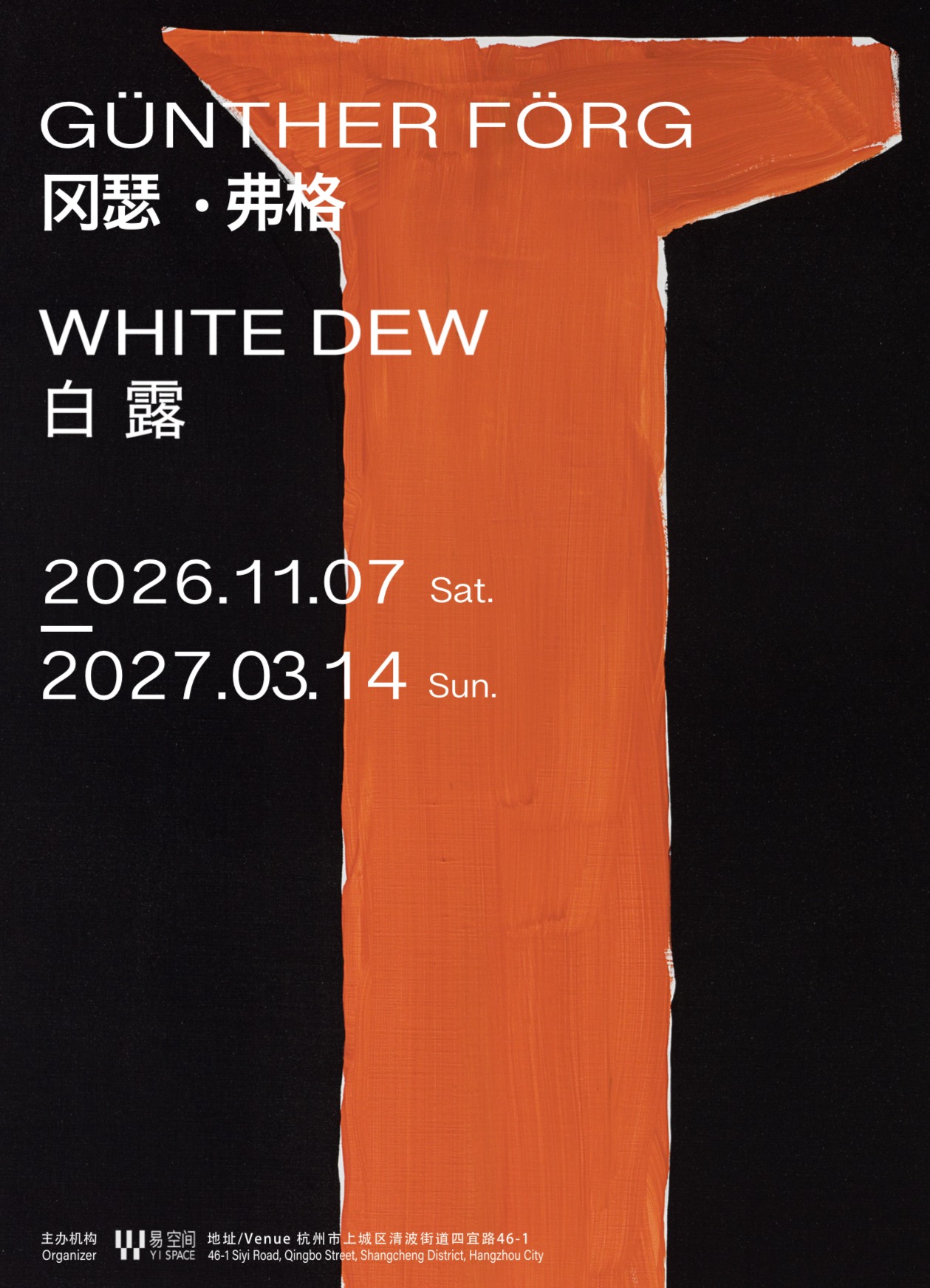
2026.11.07-2026.03.14
Artist
Günther Förg
Günther Förg
Organizer
Yi Space
Yi Space
Address
Yi Space, 46-1 Siyi Road, Qingbo Street,Shangcheng District,Hangzhou City, Zhejiang province
Yi Space, 46-1 Siyi Road, Qingbo Street,Shangcheng District,Hangzhou City, Zhejiang province
“Painting is an elastic practice: throughout the history of painting, it has not actually changed very much; we always view it in the present, and painting still belongs to the present.” —Günther Förg
White Dew and Beginning of Winter are two nodes among the twenty-four solar terms, marking the shift from cool to cold and from release to gathering.
The “white” of “White Dew” is not a color, but a threshold where the formless is about to take form and the visible is about to recede; it is the gray-white texture of acrylic after settling on canvas, the breathing quality of pale light whitening on paper, the gentle surface of a white wall that has lost its luster, and also the fleeting reflection of the work as it falls upon the viewer’s gaze.
Grids, color fields, repetition, and blank space recur on canvas and paper—not as nostalgic retrospection, but to slowly develop the voids and residues beneath the skin of modernism. Form was once utopia, and also an apparatus of obstruction and reflection. When viewers encounter their own position between image and space, the exhibition space is no longer a neutral container. Viewing becomes a continuously drifting gaze; the work does not deliver stable meaning, but only provides the conditions for condensation.
This exhibition does not seek evidence of Eastern aesthetics in Günther Förg’s works; instead, it uses the temporal gap between “White Dew” and “Beginning of Winter” to reposition the entrance to viewing. The works are not ordered chronologically, but juxtaposed according to “states of condensation”: covering and fading, accumulation and scraping, appearing and disappearing, order and void. The exhibition is not arranged linearly according to the time of creation; rather, it reorganizes pictorial relations through “states of condensation,” allowing light, surface texture, spatial atmosphere, and the viewer’s bodily perception to resonate with one another.
Viewing is no longer simple image consumption, but an entry into an aesthetic cycle of continuous reflection and endless deferral.
White Dew has never truly passed; it condenses in the layers of acrylic on canvas, in the fibers of paper, and in the viewer’s pupils. Form is like dew: it precipitates from the formless and dissolves in the gaze. All forms are momentary condensations; all viewing is a gentle brush past.